
اليكم الان An Unexpected Visit والان إلى التفاصيل من المصدر موقع يمنات الأخباري
yemenat
Yemenat
Mohammed Al-Mekhlafi
Two days ago, I went out with my son, Ayham (11 years old), at nine in the morning to Restaurant Street in Tahrir Square, in the heart of Sana’a. The weather was beautiful, and the sky was covered with thick clouds that promised rain.
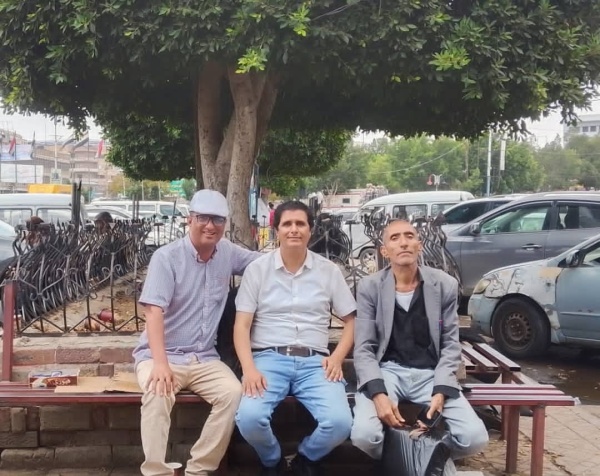
After breakfast, I headed, as I usually do, to a place near the square where a number of friends gather on benches beneath the trees. Among them are writers, poets, and authors, most of whom belong to the generation that witnessed Yemen’s newspaper industry and cultural life.
There, they find a brief escape from daily routines. They exchange stories and revisit memories of seminars, book fairs, and literary events that were held from time to time in many Arab and international capitals. They remain there until shortly before noon, then leave.
On our way home, we passed by the entrance to the Military Museum. Ayham asked me if we could go inside to discover what it contains. We bought tickets and entered.
The museum was almost empty of visitors. I remembered my days as a tour guide twenty years ago, when the place was filled with tourists from different nationalities, almost like a bustling marketplace.
We were welcomed by the museum guide, Mr. Adel Halboon, with a warm smile. As he began explaining the history of some of the archaeological artifacts on display, some of which date back thousands of years, I asked him whether photography was allowed.
“Yes,” he replied.
I then asked for permission to record his explanations as he spoke about the artifacts. I told him that I intended to write an article about the visit and share some of what the museum contains.
“With great pleasure. You are welcome to do so,” he said.
He continued by pointing to a collection of glass vessels belonging to Queen Belqis, which she used for perfumes, cosmetics, and personal adornment. According to him, these vessels were examined in Italy using modern scientific methods and technologies, which determined that their age is approximately three thousand years.
He then referred to the verse in the Holy Qur’an:
(She uncovered her legs. He said, ‘Indeed, it is a palace whose floor is made of smooth glass.’ She said, ‘My Lord, I have wronged myself, and I submit with Solomon to Allah, Lord of the worlds.)
He added that the museum also contains a kohl container once used by Queen Belqis as part of her cosmetic tools, as well as a gold kohl applicator, which, according to the guide, is preserved in the museum’s storage collection.
He then moved on to the ancient city of Baraqish, located in Al-Jawf Governorate in northeastern Yemen, and mentioned the well-known Yemeni proverb:
(Baraqish brought destruction upon herself.)
After that, we moved on to examples of the correspondence exchanged between the Prophet Solomon and Queen Belqis.These were round cases used to preserve and hold the letters after they had been rolled up before being sent. The letters were written in the ancient Musnad script.
Also on display is a marriage contract written in the local Za’bor script on palm wood sticks. It is considered one of the oldest surviving manuscripts in Yemen.
What captivated me most was a tiny statue of a child, regarded as one of the smallest sculptures in the world. It was carved by a Yemeni artisan nearly three thousand years ago with remarkable precision and craftsmanship.
We also saw the letter sent by the Prophet Muhammad peace be upon him to Al Munthir Ibn Sawa Al Tamimi, the ruler of Bahrain, inviting him to embrace Islam or pay the jizyah.The letter bears the Prophet’s seal, and its text is written in an undotted script.
In the weapons gallery, we saw spherical catapult stones that were used during the medieval Islamic period. They were coated with oil and ash, set on fire, and then launched toward castles and fortresses to burn and destroy them.
Beside them were iron suits of armor worn by soldiers for protection against swords and daggers.
The guide then led us to a collection of ancient Yemeni swords and spoke about their historical significance.
He highlighted the reputation the Yemeni sword had enjoyed since the early days of Islam and the accounts that mention the quality of its craftsmanship and its strength.
He also referred to the Battle of Mu’tah, where it is said that nine swords broke in the hands of Khalid Ibn Al Waleed, may Allah be pleased with him, during the fighting, while the Yemeni sword withstood the entire battle. He added that the Prophet Muhammad, peace be upon him, would have swords brought from Yemen during the early years of Islam because of their renowned quality and durability.
Alongside them are three janbiyahs representing Yemen’s major tribal confederations. From right to left, they belong to Hashed, Bakeel, and Mathhaj. They form an integral part of Yemen’s identity and cultural heritage and are distinguished by the diversity of their shapes, ornamentation, and symbolic designs from one tribe to another.
The museum also displays old Arab firearms that rank among the earliest guns manufactured in Yemen. They were loaded with gunpowder, ignited with a slow match, and fired very small pellets resembling what are locally known as zaraqif. These firearms remained in use during the early twentieth century, with some dating back to 1902.
The museum also houses other rifles that were used primarily for ceremonial display, particularly during the Ottoman period, alongside a Maxim machine gun manufactured in Germany during the First World War and brought to Yemen by the Ottomans.
Also on display are the gravestones of Ottoman soldiers, which remain remarkably well preserved and reflect the craftsmanship of the Turks during their presence in Yemen. They bear carvings of the military headgear used at the time.
Among them is the gravestone of a young soldier marked with the symbol of the Aziziye cap, associated with the reign of Sultan Abdulaziz, and another belonging to a senior soldier marked with the symbol of the Sultanic cap, associated with the reign of Sultan Abdulhamid.
Another object that caught our attention was the chair of the Ottoman governor. Standing approximately two meters high, it was designed to symbolize the authority and status embodied by the Ottoman governor at that time.
We also saw a model of a railway train representing one of the earliest railway projects in the region. The project was initiated by Sultan Abdulhamid II in 1902, before the outbreak of the First World War. It extended from Al Hudaydah to the city of Al Khawkhah, with plans to continue to the Hejaz and the Levant in order to connect the entire Arabian Peninsula.
However, the outbreak of the First World War, followed by the collapse of the Ottoman Empire, brought the project to a halt before it could be completed.
The museum also displays a German made anti aircraft gun with a range of eight kilometers. It was used during the era of the Imamate.
Beside it are military implements dating back to the era of the Imamate army, which soldiers carried behind their janbiyyahs. These include a kohl container, a mishra’ah traditional tobacco pipe, a thorn-cutting tool, hair-cutting scissors, and a tin of bordoqan (finely ground tobacco, known locally as shammah).
At the center of the museum stands a motorcycle that arrived in Yemen in 1964 and is said to have been the first motorcycle introduced into the country. The guide added that its speed was equivalent to one quarter of an airplane’s speed.
Nearby stands the automobile of Queen Elizabeth, which she used during her honeymoon in Aden and Kamaran Island while southern Yemen was under British rule.
The museum also features a model of the Temple of the Sun, whose construction dates back more than three thousand years. The temple consists of 360 chambers, corresponding to the days of the year. During the reign of Queen Bilqis, it was used to observe the sun.
Each day, sunlight entered through a window into a different chamber, making the temple function as a calendar by which the seasons could be determined. According to the guide, the queen slept in a different chamber each day throughout the year.
Also on display is a MiG 17 fighter aircraft, one of the earliest aircraft to arrive in Yemen from Russia as part of the country’s relations with the Soviet Union. According to the guide, it was presented to Yemen in exchange for grain supplies during periods of global war.
The aircraft entered service in Yemen in 1967. It was used during the Seventy Day Siege and also took part in strikes on the approaches to Sana’a following the establishment of the Republic.
Beside the taxidermied lion is a gift presented to the museum by former Libyan President Muamar Al Gathafi during his visit to Yemen in 1994. It consists of a mongoose, a mouse devouring a snake, and a monitor lizard.
This visit was entirely unplanned, and time did not allow me to cover everything. I therefore limited myself to discussing only a selection of the artifacts, even though the museum houses many more treasures that deserve careful attention.
yemenat
an unexpected visit
المزيد من التفاصيل - اضغط هنا
موقع يمنات الأخباري an unexpected visit
كانت هذه تفاصيل An Unexpected Visit نرجوا بأن نكون قد وفقنا بإعطائك التفاصيل والمعلومات الكامله .
وننوه بأن الموضوع الأصلي قد تم نشرة ومتواجد على موقع يمنات الأخباري و قام فريق العمل في برسبي نيوز بالتاكد منه او ربما تم التعديل علية او قد يكون تم نقله بالكامل اوالاقتباس ويمكنك قراءة الموضوع من مصدره الاساسي.