
اليكم الان Holden’s Voice Between Salinger’s Language and Halasa’s Translation والان إلى التفاصيل من المصدر موقع يمنات الأخباري
yemenat
Yemenat
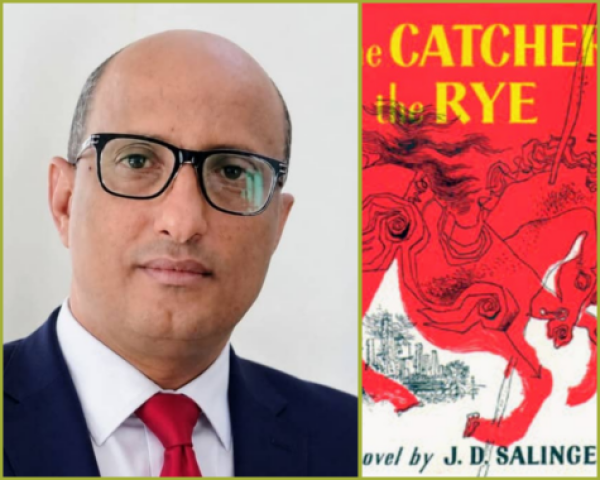
Mohammed Al-Mekhlafi
During a qat session at my friend Abdulmajed Al-Turki’s home, we talked, as we usually do, about novels and the books we had read.
He asked me if I had read the English version of The Catcher in the Rye by the American writer J. D. Salinger. I told him, “Not yet.” He said that he had read the Arabic translation more than once, that it was one of the best novels he had ever read, and that he wanted to know what Holden Caulfield’s voice was like in the original language.
After I returned home, I looked for the English edition and began reading. I expected to encounter highly literary language, especially since the novel was published in the early 1950s, but I found the opposite: the language was very simple and smooth. As I read, I felt as though I were sitting across from a sixteen-year-old speaking to me spontaneously. He seemed to complain a lot, judge things quickly, repeat certain phrases, and move from one thought to another without any clear order.
The first thing that drew my attention to this was the way he introduces his story from the very beginning, when he says:
“If you really want to hear about it, the first thing you’ll probably want to know is where I was born, and what my lousy childhood was like, and how my parents were occupied and all before they had me, and all that David Copperfield kind of crap, but I don’t feel like going into it.”
It seems that Salinger chose this style because it reflects Holden’s personality, allowing him to tell the story spontaneously, in the everyday language spoken by New York teenagers at the time. For example, when he talks about Pencey, he says: “Strictly for the birds,” meaning: “It’s all just nonsense.”
Here, he is mocking the school’s motto, which says: “We make boys into fine young men, mature in thought and clear-sighted.” What caught my attention was the way he speaks, as if the phrase had just come out of him in the moment. He does not search for the right expression; he simply says whatever comes to mind.
There is another phrase in which he says: “Be a buddy. Be a buddyroo,” meaning: “Be my friend, be my friend.” He says it with the same spontaneity and warmth.
Even swear words are part of this voice. Expressions such as “goddam tie” appear in his speech, meaning: “Damn this tie.” There are other phrases that recur throughout his speech as well. He does not carefully choose his words, nor does he try to be polite all the time. Swearing, for him, is part of the same pattern as sarcasm and complaining.
This apparent disorder is part of the nature of his memory; it is not a flaw in the writing. He says: “Some things are hard to remember,” meaning: “Some things are hard for me to remember,” which confirms that his way of recounting events is not orderly.
After I finished reading the English version, which is 115 pages long, over four separate reading sessions, I began reading the Arabic translation, published by Al Mada Foundation for Media, Culture and Arts in Baghdad, Iraq, in 2007.
It is 312 pages long and was translated by Ghalib Halasa. I read only the first and second chapters and skimmed through the rest. I was simply looking for Holden’s voice. Was he the same sarcastic and complaining teenager he was in the original?
Some might see a problem with the translation because of the large difference in the number of pages: the Arabic edition is about 197 pages longer than the English one. But in my view, this is not evidence of a problem with the translation, because the number of pages can vary depending on the paper size, the type and size of the font, spacing, and the way the book is laid out.
The nature of the language itself also plays a role. A short colloquial sentence in English can convey a broad meaning, while rendering it into Arabic may require more words to convey the same meaning and preserve its rhythm as much as possible.
I believe Halasa succeeded brilliantly in conveying the text, but in some places he made the speech more orderly and polished than in the original. In English, I felt that Holden speaks more quickly, with greater hesitation and spontaneity, while in Arabic he seems, in most places, clearer and more organized.
This is not a flaw in the translation. Translation is particularly difficult in this case. How can the voice of an American teenager speaking New York slang in the 1950s be rendered into Arabic in a way that conveys something similar? The translation here is trying to translate the voice itself, which is the key to the novel.
Let us return to Holden. He does not trust what people say about themselves very much, and the word “phony,” meaning “fake,” recurs throughout his speech, revealing the way he sees the world around him. He sees phoniness in the school, in the teachers, and in a society that cares about appearances. He hated studying and failed many times until he was expelled from school.
But the paradox is that Holden himself lies. He changes his name, makes up stories, and talks to people he does not know as if he were someone else. He hates lying, yet he does it. He wants the truth, yet he hides behind stories. And this is what leaves him confused as he tries to understand the world around him.
When his brother Allie dies, the tone of the novel suddenly changes. After all that anger and complaining, another child emerges within Holden—a child who loves and grieves, and tries to hold on to his innocence despite everything around him.
And this brings us to the idea that gave the novel its title. When Holden hears a child singing:
“If a body catch a body coming through the rye”
meaning: “If someone catches another person as they cross the rye field.”
The song turns into a clear image in his mind. When his sister Phoebe asks him what he wants to become, he says that he wants to stand in the rye field and keep children from falling over the cliff.
He does not want to become like the adults he mocks. Instead, he wants to protect innocence before the world corrupts it, and perhaps he is also trying to protect himself.
Holden lives in a society that talks constantly about competition, success, and money. But he looks at this world through the eyes of an angry and confused boy, and perhaps that is why he feels so close to the reader.
I believe that Holden, despite all his contradictions, is a boy trying to understand the world around him.
yemenat
holden s voice between salinger s language and halasa s translation
المزيد من التفاصيل - اضغط هنا
موقع يمنات الأخباري holden s voice between salinger s language and halasa s
كانت هذه تفاصيل Holden’s Voice Between Salinger’s Language and Halasa’s Translation نرجوا بأن نكون قد وفقنا بإعطائك التفاصيل والمعلومات الكامله .
وننوه بأن الموضوع الأصلي قد تم نشرة ومتواجد على موقع يمنات الأخباري و قام فريق العمل في برسبي نيوز بالتاكد منه او ربما تم التعديل علية او قد يكون تم نقله بالكامل اوالاقتباس ويمكنك قراءة الموضوع من مصدره الاساسي.