
اليكم الان Coca-Cola innovation labs test dirty sodas, refreshers والان إلى التفاصيل من المصدر بتوقيت بيروت_ beiruttime
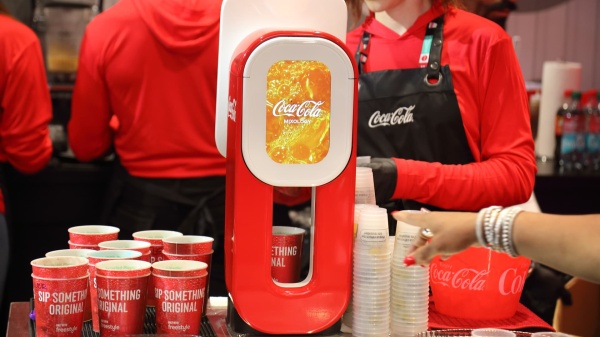
Coca-Cola used its new Mixology dispenser to make refreshers at the National Restaurant Association show.
Source: Coca-Cola
ATLANTA — Coca-Cola is branching out into new customizable drinks and trend-driven equipment as consumers — and food service operators — increasingly want more options.
Tucked away in an anonymous office park not far from its global headquarters here, Coke has been working on a flood of innovation at its secretive labs, including a way for its Freestyle drink dispensers to make dirty sodas, which combine pop with flavored syrups, cream or other ingredients. In partnership with AMC Theatres, it is testing a Micro Matic dispenser that can make brightly colored refreshers. And Coke has more white-label beverage options on the way, like an energy drink that can be customized by color and flavor.
For many restaurants, handcrafted drinks like refreshers or iced coffee have become an important way to drive traffic and sales, even as diners broadly cut their spending. In the second quarter of this year, beverage servings at restaurants outpaced both servings of food alone and food with beverages, according to Circana data. When consumers are away from home, a drink often represents more than hydration, particularly for Generation Z.
“Oftentimes these beverages are an opportunity to take a break, get some energy or protein, have a treat, at a lower price point,” David Portalatin, Circana senior vice president and food service industry advisor, told CNBC.
From McDonald’s to Wendy’s, longtime Coke customers have been expanding their beverage offerings to meet the shift in consumer behavior and boost their profit margins. As operators seek to add more drinks to their menus, Coke must add more convenient beverage options — or risk losing sales to a competitor.
“It’s our job to ensure that we’re providing unique experiences and beverages because it’s not a bonus now with consumers — it’s the norm, they expect it,” said Megan Tallman, Coke’s vice president of dispensed equipment and innovation for its North American business. “When you think about Gen Z, they are okay paying $10 for a drink that is craveable and that they can show on their Instagram or on TikTok, which is helping our customers drive margin and also beverage attachment.”
Beyond Freestyle
This July, Coca-Cola’s Freestyle drink dispenser celebrated its 17th anniversary.
“Honestly, if you fast forward to today, Freestyle is more relevant today than probably it was over a decade ago,” Tallman said, crediting the machine’s dozens of flavors.
Even with the variety it offers, Coke is still trying to evolve to keep up.
In the time since the Freestyle was introduced, the number of specialty beverage chains has exploded, offering customers nearly unlimited ways to customize their drinks, from sugar content to toppings. Market research firm Technomic tracks more than 100 different chains, with more than 41,000 locations across the U.S. combined, selling everything from coffee to juice to boba.
Ever since Freestyle began popping up in restaurants and movie theaters, the dispensers have poured more than 67 billion 8-ounce servings of beverages; Coke has been able to track them all, thanks to the equipment’s real-time data collection. That data is coming in handy now.
Inside its Equipment Innovation Center in Atlanta, a massive television screen displays real-time data showing what drinks dispensed by the Freestyle are trending, what time of day and where — from the region to the type of business. AHA sparkling water, for example, is trending up at office buildings and hospitals.
Insights from Freestyle dispensers also help the company discover new drinks that it can launch in grocery stores, like the limited-time Coca-Cola Orange Cream, which combines its namesake soda with vanilla and orange syrup.
“If we see that the flavors that we’re offering to consumers in food service are actually resonating — it’s the largest testing platform out there,” Tallman said.
But Coke has more ideas in store.
First is the Freestyle Mini, which initially launched in Europe. Intended for bars and restaurants with limited space, the dispenser holds up to 16 drink options, more than double the choices available in a traditional soda gun. Coke unveiled the new smaller machine at the National Restaurant Association Show in Chicago this spring, but the company has not yet sold it to customers in the U.S.
The Coca-Cola Freestyle Mini offers more drink options than the traditional soda gun found behind the bar.
Coca-Cola
And then there are other equipment ideas that aren’t as far along, inspired by Coke’s desire to branch out into dirty soda, refreshers and coffee.
To automate dirty soda, Coke has created a prototype that adds a dairy module to the classic Freestyle dispenser. Utah-based chain Swig takes credit for its invention of the dirty soda, although the trendy drink has now spread far and wide, from KFC restaurants to grocery store shelves.
The trend has helped to change soda’s image from a tired, mass-market drink to a handcrafted beverage that can be a treat.
“Gen Z is the first generation raised to believe that nothing you consume is neutral, so everything is either helping you or costing you,” said Matthew Greer, food, agribusiness and beverage analyst for Truist. “So, traditional soda does nothing for me, and it gives me 40 grams of sugar, so that fails the test.”
The rise of a dirty soda is boon for Coke, because pop is still its number one category. Coke’s sparkling soft drinks business, which houses soda brands like Sprite, Schweppes and Fanta, still accounts for 69% of the company’s overall unit case volume, even as other ventures like coffee and dairy-based beverages have grown. Coke’s namesake soda alone accounted for 47% of global unit case volume and 42% of U.S. unit case volume in 2025, according to a company filing.
Coke’s prototypical dispensed dirty soda comes with a preprogrammed recipe, allowing for little customization but eliminating mess. The prototype, which took roughly three weeks to create, keeps the recognizable drip down the sides of the cup, giving the dirty soda its trademark visual appeal.
Refreshing its offerings
Beyond the Freestyle, Coke is also testing Micro Matic “mixology” dispensers to make refreshers and iced coffee drinks. Starbucks created the refresher back in 2012 to appeal to non-coffee drinkers who wanted a boost, especially in the afternoon, when traffic to its cafes slowed. Customers can pick their bases, flavors and even caffeine level. Refreshers now represent about $2 billion in annual sales for Starbucks. Other restaurant chains, such as Panera Bread to Dunkin’, have taken note. Refreshers can be found on 8.1% of menus at national restaurant chains, according to Datassential. “It’s almost, I think, a compliment, the fact that our Refresher business is being imitated in so many places,” Starbucks CEO Brian Niccol said on the company’s earnings conference call in late April. For its part, Coke is hoping to make its mark on the refresher category — whatever that means.
“There’s no real definition for what a refresher is, so we’re trying to take a stand on what that can be and what function that we believe it should deliver to the guest,” said Sarah Kate Sims, director of dispensed innovation for Coca-Cola North America. To Sims, a refresher is a “healthier” beverage that delivers some kind of pick-me-up without a traditional coffee caffeine base, instead using a green tea or a natural coffee extract as a base. And a refresher must look good, too, she said. “So that’s what I’m working on for next year,” Sims said.
Inside ‘The Vault’
Coke’s innovation efforts aren’t restricted to equipment either. Across the parking lot from its Global Equipment Platforms office is “The Vault,” where the company tests new drinks. “We bring a lot of our top customers here to showcase our innovation and mixology, but also to collaborate and problem-solve and tackle the biggest challenges in the business,” said Caroline Zambataro, collaboration architect at Coke. One of those customers is Whataburger. Coke worked with the Texas-based burger chain for about 18 months on its line of “Whatafreshers,” which launched in July. In some cases, consumers might not even realize that they are drinking a Coke product. For example, the company considers itself a “pioneer” of premium lemonade after launching a white-label version more than a decade ago. More than 40,000 bubbler dispensers carry the drink, according to Tallman.
That number includes Wendy’s, which sells it under “Dave’s Craft Lemonade,” after founder Dave Thomas.
: تونس تجني 1.6 مليار دولار من صادرات زيت الزيتون خلال 9 أشهر
Megan Tallman, vice president of dispensed equipment and innovation for Coca-Cola’s North American business.
Source: Coca-Cola
These days, lemonade is a popular base for a lot of refreshers and other brightly colored drinks. So, too, is Sprite, which ranked fifth among U.S. carbonated soft drink brands by 2025 sales volume, according to Beverage Digest.
But Coke is also working on a new blank slate for handcrafted beverages: a colorless, relatively unflavored energy drink that comes in frozen or liquid form. The company plans to launch the beverage with food service operators in the first half of 2027.
Energy drinks are a much smaller category than sparkling beverages, but the segment has the highest expected growth projections for the next 10 years, according to Tallman.
“We believe this solution really meets many consumers because more female consumers are interested in energy if it’s a handcrafted solution,” Tallman said.
Starting with Celsius, the conversation around energy drinks has changed, widening their audience and the number of occasions where they can be consumed, Truist’s Greer said. Rather than a beverage that you buy at the gas station for a pick-me-up, now energy drinks can become a part of some consumers’ workout routines.
Coke’s take on energy drinks will be designed to be served by employees to “limit consumption,” according to Tallman. A 12-ounce serving of Coke’s version contains 106 milligrams of caffeine, roughly the same amount as the same size can of Red Bull and half of the caffeine content of a Celsius can. Excessive caffeine consumption has become a liability concern after Panera Bread’s Charged Lemonade was named in at least two wrongful death lawsuits.
A golden opportunity
Broadly, Coke has been fielding more inquiries from food service partners these days about customizable drinks, according to Melinda Pritchett, director of innovation for Coke’s North American business.
“If you’re looking at what McDonald’s is doing with the handcrafted beverages, all of our customers are saying, ‘We should be in that as well,'” she said.
As the largest U.S. restaurant chain by system sales, McDonald’s playbook is often replicated elsewhere. In May, the fast-food giant expanded its McCafe menu in the U.S. to include refreshers and crafted sodas, including Coke’s Sprite and Hi-C, as part of its broader strategy to lean into beverages.
“In the U.S., (drink) sales are ahead of plan. Guest checks are higher, and we’re seeing new occasions emerge throughout the day,” McDonald’s CEO Chris Kempczinski said on the company’s earnings conference call earlier in August. “We’ve also seen strong food attachment rates on these orders.”
But the drink launch arrived during what was otherwise a lackluster quarter for McDonald’s U.S. business, which reported same-store sales growth of just 0.8%. The company has replaced its U.S. president in the hopes of accelerating its domestic division.
On Monday, McDonald’s further expanded its beverage options with the Red Bull Dragonberry Energizer. Red Bull is privately owned, with no connection to Coke. The chain’s choice to partner with a competitor rather than using an energy drink affiliated with Coke, like Monster, has sparked speculation about the state of the companies’ more than 70-year-long relationship.
“We have a fantastic and very long-standing partnership with McDonald’s, and that’s intact, right? We continue to be very happy with that partnership,” Coke CEO Henrique Braun said on the company’s earnings conference call in late April, answering an analyst question about the partnership. “… We do respect the decisions on other choices about their relationships with other companies.”
Ultimately, the most important part of any business relationship is the effect on sales.
When testing a new beverage with a food service partner, Coke tracks a couple of different performance metrics, like “incremental volume.” In other words, would a customer buy one of the new refreshers even if they wouldn’t otherwise buy a drink?
A survey of several dozen U.S. McDonald’s franchisees conducted by Kalinowski Equity Research found that more than half of operators said the specialty drinks are performing in line with their expectations.
“They are selling great, but most of it is a trade-off from other beverages,” one anonymous franchisee said in the survey. “Not many new transaction counts.”
: أزمة نقص تاريخية في قطاع الماشية تدفع أسعار اللحوم لمستويات قياسية
Choose CNBC as your preferred source on Google and never miss a moment from the most trusted name in business news.
المصدر الأصلي:
www.cnbc.com
تاريخ النشر لدى المصدر:
2026-08-22 15:00:00
: مجموعة السبع في مواجهة فخ الديون
كاتب المصدر:
نُقل هذا المحتوى آلياً من المصدر المشار إليه أعلاه، وتبقى حقوق المحتوى والمعلومات
للمصدر الأصلي. قد يخضع النص لمعالجة أو ترجمة آلية قبل النشر.
coca cola innovation labs test dirty sodas refreshers
المزيد من التفاصيل - اضغط هنا
بتوقيت بيروت_ beiruttime coca cola innovation labs test dirty sodas refreshers
كانت هذه تفاصيل Coca-Cola innovation labs test dirty sodas, refreshers نرجوا بأن نكون قد وفقنا بإعطائك التفاصيل والمعلومات الكامله .
وننوه بأن الموضوع الأصلي قد تم نشرة ومتواجد على بتوقيت بيروت_ beiruttime و قام فريق العمل في برسبي نيوز بالتاكد منه او ربما تم التعديل علية او قد يكون تم نقله بالكامل اوالاقتباس ويمكنك قراءة الموضوع من مصدره الاساسي.