
اليكم الان All I Had with Me Was My Bag and My CV والان إلى التفاصيل من المصدر موقع يمنات الأخباري
yemenat
Yemenat
Mohammed Al Mekhlafi
I slowly opened my eyes to the sound of passengers getting off the bus. I turned to one of them and asked, “Where are we now?”
He replied, “We’re at Al-Wadiah border crossing. Take your bag and get off for inspection.”
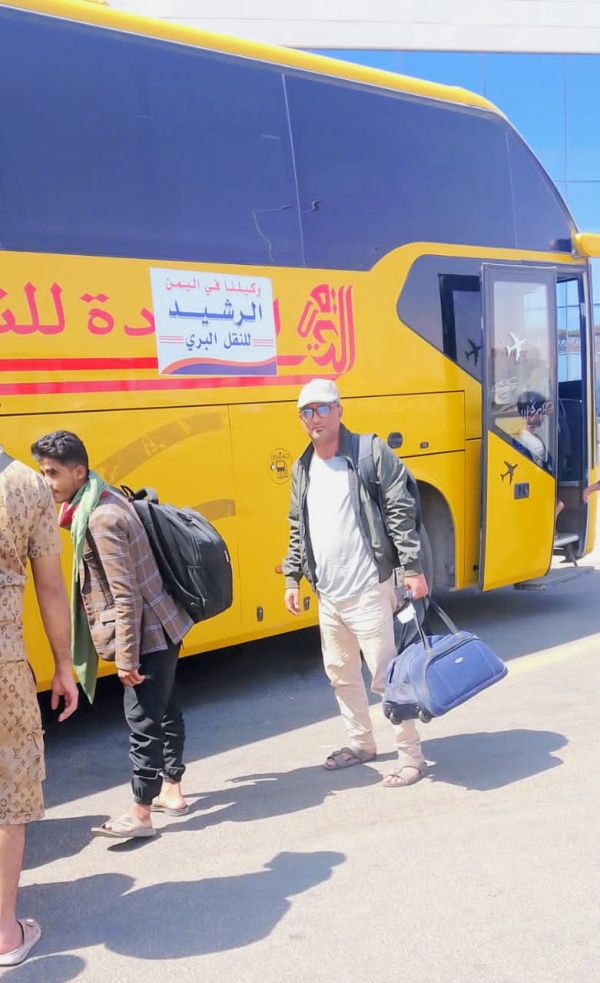
I got off the bus and placed my belongings alongside the other passengers’ bags in the designated inspection area, inside a large yard where several buses were parked in rows. The sun was high, and I was exhausted from the long journey.
After completing the inspection procedures, I returned to my seat on the bus and leaned my head back.
Somewhere between being awake and falling asleep, my thoughts took me back to Sana’a, to the moments of saying goodbye, and to the voices of my two sons: Ayham, who is eleven, and Kenan, who is six.
On the day I was leaving, I deliberately kept my sons home from school because I wanted to spend some time with them before my departure. That morning, I took them to Al-Tahrir Square. We had breakfast on Restaurant Street, then went to Bustan Al-Sultan Park, which is close to the square.
There, I told them that I was travelling that day. Ayham prayed for me and said he would miss me very much. Kenan, however, could not hold back his tears. He started crying and said, “Dad, I want to come with you to Saudi Arabia.” It was a difficult moment for me, but I tried to reassure him.
Around noon, we returned home and had lunch. Then I started getting ready for the journey. It was raining, and thick, dark clouds covered the sky. At three in the afternoon, I left home with my family in a taxi, heading towards Southern Sixty Street, where the buses depart from.
When we arrived, the employee told me that the buses were parked in a yard on another street. We walked a short distance in the rain, then took another car that dropped us off there. The place was small, with only two buses. I handed the employee my passport. He took a photo of it with his phone and told me that my name was on the passenger list.
I gave him my bag, then stopped a taxi to take my family back home. After that, I returned to the yard, got on the bus, and waited for the remaining passengers to arrive.
Just before we were due to leave, I heard someone calling out. I got off the bus to find out what was happening. The employee told me that the office where I had booked my ticket had not paid the full amount.
I tried to contact the office, but no one answered.
In a hurry, I took a motorcycle taxi to the office, only to find that the guard was the only person there. I waited for about twenty minutes until the employee arrived. I said to him, “This is not right. Why did you do this? Why didn’t you pay the full amount?”
He apologised and blamed his colleague. Then he asked me to pay the remaining amount and promised to return it the following day. I had no other choice, so I paid and went back to the bus.
We left Sana’a at 7:30 in the evening. It was the first time I had travelled on an international bus at night. My clothes were still wet from the rain, and I could feel the cold running through my body.
I was looking out of the window when I got the impression that we were driving over a bridge, with cars passing along the road below us. But then I realised that it was simply the height of the passenger seats that had given me that impression.
The bus was crowded. Families were seated at the front, while my seat was second from the back. Most of the passengers were chewing qat and chatting with one another. Some kept repeating, “Today is the last day for qat. Make the most of it, guys.”
We headed south towards Aden, and the bus was quiet.
We stopped in Ma’bar for about an hour to have dinner before continuing towards Yarim. When we arrived, the driver got on the bus and said, “Passengers travelling to Makkah and Jeddah, please move to the other bus.”
We collected our belongings and moved to the other bus, only to find that it was old and in poor condition.
We reached Damt at around three in the morning. The driver told us that we would have to wait until 5:30 a.m., when the checkpoint at the entrance to Al-Dhalea would open.
As we approached the checkpoint, we were surprised to see a long line of cars and trucks. We waited for nearly three hours before it was our turn to pass through. We then underwent a thorough inspection. We arrived in Al-Dhalea at around 11:30 a.m. and stopped there for lunch.
Suddenly, the driver told us that the road connecting Al-Dhalea city to Lahj was closed because Aden International Airport had been targeted. I was exhausted and had not slept at all during the night.
Among the passengers was an elderly man with a beard, wearing a white thobe, a coat, and a scarf wrapped around his head. He looked exhausted, and some juice had spilled on his thobe, leaving it stained. There was also a woman trying to calm her baby, who had been crying for most of the journey.
The driver had no choice but to take another route through the countryside of Al-Dhalea. We drove up mountains and down steep slopes. I kept asking the passengers about the names of the places we were passing through, but none of them knew.
After about two hours, we reached a place that looked familiar to me. I wanted to make sure, so I turned to the man sitting next to me and asked:
“Is this Al-Anad?”
He said, “Yes.”
I sighed and said:
“Oh God! The journey from Al-Dhalea city to Al-Anad used to take less than an hour. Today, it has taken us two and a half hours.”
An elderly man sitting nearby heard me and said, “My son, we used to travel through the Al-Tuwal border crossing in the morning and have lunch in Saudi Arabia. But look at us today. Saudi Arabia is north of Yemen, yet we travel south, then head east and go all the way around Yemen.”
Before reaching Lahj, we turned east. The road was almost empty of traffic. Most of the passengers had fallen asleep, while some stretched out on the floor between the seats, trying to find a little space to rest.
At three in the morning, we reached Shaqra. We stopped there for breakfast, then continued towards Abyan. I eventually fell asleep and knew nothing about what was happening until I woke up and asked the man next to me, “Where have we reached?”
He told me that we had already passed Abyan.
We continued our journey until the bus stopped at a petrol station. I noticed a sign with the word “Lahmar” written on it, in Shabwah. After that, we headed towards Hadramawt along the desert road through Al-Abr, most of which was unpaved.
At the Al-Wadiah junction, we stopped, and the driver asked us to take all our belongings off the bus so it could be cleaned. A man then got on and spent nearly an hour cleaning it carefully.
I sat beside one of the shops, looking at the desert landscape around me. The mountains caught my attention with their different shapes. Some looked like ships, while others had completely different forms. I asked several people about these mountains. They told me that they were connected to the story of the people of Thamud, who carved their homes into the mountains. At that moment, I remembered the Quranic verse: “And you carve homes out of the mountains.”
After that, we headed Al-Wadiah junction checkpoint. One of the officers came onto the bus to check our passports and visas. Then we continued towards Al-Wadiah border crossing.
I fell asleep again and did not wake up until I heard the passengers moving around and getting ready to leave the bus. I asked one of them, “Where are we?”
He told me we were at the first gate of Al-Wadiah crossing, at the weapons checkpoint.
We got off and went through the inspection. Then we entered the main border area to complete the departure procedures. Each of us paid ten Saudi riyals for the exit stamp. It was around midday.
We had lunch, then stayed there until nine in the evening, surrounded by dust and metal sheds. The buses were parked in neat rows, and there were around twenty of them.
At nine, we got back on the buses and moved to another yard for inspection. This time, the checks were more thorough and continued until five in the morning.
As we approached the Saudi border, we were welcomed by a large gate and a wide, paved road. There was no dust or confusion. I felt as if we were entering an international airport rather than a land border crossing. The place seemed fully equipped, and the attention given to travellers’ comfort was clear in every detail.
At the first gate, they gave us a vaccination shot, then directed us to the arrivals hall. The procedures were smooth and quick, and the staff treated us well.
One thing that caught my attention was a young man travelling with his elderly mother. He told the Saudi officer that his mother had a heart condition. The officer immediately went to get his own wheelchair and asked the son to help his mother sit in it. He then pushed the wheelchair himself all the way to their car and asked the security officer to let them leave without delay.
After nearly seventy hours on the road, we finally entered Saudi Arabia. The road was wide and comfortable. We stopped for lunch at a restaurant near the Al-Wadiah border crossing. The restaurant was clean, the food was delicious, and it felt more like a place in one of the city’s finest neighbourhoods than a restaurant in the middle of the Empty Quarter desert.
We continued towards Makkah, passing through Sharurah, Sultanah, Wadi Al-Dawasir and Ranyah, before heading towards Taif.
That night, I kept watching the road through the window. The passengers around me were asleep, and some were snoring. I tried to recognise the places we were passing, but I was completely exhausted. At times, my tiredness made me imagine that the bus was climbing a steep road, then stopping and rolling backwards, even though it was moving normally.
On the morning of the fifth day, we arrived in Taif. The weather was cold, and I felt as if I had returned to Sana’a. The bus stopped for a while, and some passengers got off, including the elderly man whose thobe was still stained with juice.
While we were sitting beside the bus, a car pulled up. A young man got out, looking very much like the elderly man. He walked towards him, kissed his feet, his knee and his head, then hugged him, opened the car door and helped him inside.
After that, we continued our journey until we reached the Miqat. The bus stopped, and the driver asked the passengers who were going to perform Umrah to get off and go to the mosque to wash and put on their ihram clothes.
We got off the bus, washed, and put on our ihram clothes. The area was full of pilgrims, old and young, including children. A well-built young man standing next to me asked me to help him wrap the ihram cloth around his shoulder. After that, we entered the mosque and prayed two rak’ahs in preparation for Umrah.
We returned to the bus, and as we got closer to Makkah, we began reciting the Talbiyah:
“Labbayk Allahumma Labbayk. Labbayka la sharika laka labbayk. Innal-hamda wan-ni’mata laka wal-mulk, la sharika lak.”
I noticed that the passengers’ faces had changed. The young man who had been sitting next to me, wearing a thobe, a coat and a Kashmiri jacket, with his woollen scarf wrapped around his head, had been chewing qat, his eyes reflecting how much he was enjoying it. But now, after washing and putting on his ihram, his face seemed to light up as he recited the Talbiyah, ready to perform Umrah with his whole being.
We continued towards Makkah. The closer we got, the greater my happiness became. I could not put what I was feeling into words, so I simply prayed from the bottom of my heart.
Suddenly, one of the passengers said excitedly, “Look, there’s the Clock Tower!” He pointed towards it, and we all turned to look. We could see the Clock Tower in the distance.
The bus stopped on Hajj Street. The pilgrims got off, collected their belongings and left. I stayed there for nearly an hour because I did not know the area. It was my first time in Makkah.
I had been in touch with Mohammed Hammoud, my nephew, who lives in Jeddah. He had told me that he had contacted some friends to welcome me, but they were at the mosque attending Friday prayers.
Suddenly, I received a call from Harith Abduljaleel Al-Qaisi (Abu Raslan). He welcomed me and told me that he had sent a taxi to take me to a restaurant for lunch and then drop me off at my accommodation in Al-Otaibiyah.
After the Maghrib prayer, I went to the Grand Mosque to perform Umrah.
When I entered the mosque, I asked an Indonesian man where the entrance was. He gestured for me to follow him. I went down and walked closer to the Kaaba. At that moment, I felt a deep sense of awe, and my heart filled with a spiritual feeling I had never experienced before.
I began performing Tawaf among people of different nationalities, men, women and children. I prayed from the bottom of my heart, with tears running down my face. They were extraordinary moments, unlike anything I had ever experienced.
I thought of my parents, may God have mercy on them, my children, my family and my friends. I prayed that God would guide them and put their affairs right. I also prayed for an end to the suffering of our people in Yemen, that they would put their differences aside and come together again.
After Tawaf, I went to the walkway and began Sa’i between Safa and Marwa. Despite the exhaustion from the long journey and the pain in my swollen leg, I kept going until I completed it.
While I was performing Sa’i, I received a message from the landlord of the apartment where I live in Sana’a. He was asking me to pay three months of overdue rent and threatening to evict me if I did not pay.
I never expected to receive such a message at that particular moment. I sent him a video and told him that I was performing Umrah. I prayed for him, his family and his late father, and promised that I would do my best to pay the rent. He calmed down afterwards and asked me to pray for him.
After completing Sa’i, I went out into the courtyard beside the Grand Mosque. I sat there looking at the surrounding buildings and the Clock Tower. The courtyard was full of families, and children were playing around.
After that, I went to a barbershop and had my head shaved. With that, I had completed my Umrah, praise be to God.
That night, my cousin Abdullah Abdu Hamed got in touch with me. He had left the village when I was a small child, and I could hardly remember what he looked like. He came and picked me up in his car and took me to his home. We had dinner and talked for a while, then I slept deeply until morning.
The following day, Harith contacted me, and I went to his shop, “Koshati Ghair”, on Al-Andalus Street in Al-Otaibiyah. The last time I had seen him was more than twenty years ago. He was very cheerful, with a smile that never left his face.
I spotted him from a distance, standing in the street near his shop. He was tall, with thick hair, wearing a white thobe. He had not changed much from what I remembered. He was still spontaneous and cheerful, with a natural charisma that made him stand out.
I greeted him warmly and sat with him for a while. Then he asked his cousin Hamza Fouad to take me to the accommodation in the Shaab Al-Dhab neighbourhood.
I was surprised when I arrived to find that everyone staying there was either from my village or a relative of mine. I had last seen some of them about fifteen years earlier. Among them were my cousin Abdulhakim Al-Numani, Al-Jabali and his brother Omar, his nephew Mohammed Abdu, and Salah Al-Qaisi.
I went into one of the shops and asked the worker, who appeared to be from Bangladesh, about a few things. He paused for a moment as if trying to understand what I was saying, then replied, “Ma fi ma’loom,” meaning that he did not know. They did not seem particularly welcoming to customers either, and rarely smiled. Perhaps that is simply part of their culture.
Engineer Hamed Abdullah Abdu got in touch with me and took me on a drive around most of Makkah’s neighbourhoods. I saw the towers surrounding the Kaaba, the wide, well-organised streets, the tunnels and the bridges.
Six months earlier, I had resigned from my job because of the worsening situation in the country. I tried to obtain a work visa for Saudi Arabia and paid part of the cost, but after all that waiting, it was cancelled. I had no other option but to get an Umrah visa and travel to Saudi Arabia in search of a job.
With the help of Engineer Hamed, I contacted several institutions and sent them my CV. I am still waiting to hear back from them.
I do not know what the coming days will bring, but my faith in Allah remains strong. I hope I will not have to return to Sana’a until I find a job opportunity in Saudi Arabia.
yemenat
all i had with me was my bag and my cv
المزيد من التفاصيل - اضغط هنا
موقع يمنات الأخباري all i had with me was my bag and my cv
كانت هذه تفاصيل All I Had with Me Was My Bag and My CV نرجوا بأن نكون قد وفقنا بإعطائك التفاصيل والمعلومات الكامله .
وننوه بأن الموضوع الأصلي قد تم نشرة ومتواجد على موقع يمنات الأخباري و قام فريق العمل في برسبي نيوز بالتاكد منه او ربما تم التعديل علية او قد يكون تم نقله بالكامل اوالاقتباس ويمكنك قراءة الموضوع من مصدره الاساسي.